Wednesday, July 1, 2009

If Long Beach had surf, would more people visit?

Image from Surfline.

The obvious answer to this question is yes. The more challenging question is how many people would come to surf. Predicting how many people would come to visit Long Beach to surf would likely depend on the quality of the surf and how often the surf was good.

The Long Beach Chapter of the Surfrider Foundation has a long running campaign to "Sink the Breakwater and Restore the Shore"


As part of their campaign they convinced the City of Long Beach to do a feasibility study of the breakwater removal. Part of that study was an economic analysis of the benefits to tourism resulting from improved water quality, beach conditions & surfing.

To better understand how the surfing would improve and how many surfers might visit, the Chapter contracted with Sean Collins at Surfline (a leading surf forecasting site) to use their models, historical surf records and expertise to predict how many days of surf Long Beach would see, how many good days and how many poor days and then estimated how many surfers would show up to surf it.

You can read this very interesting report here.

So what's the conclusion? Based on this approach, Collins estimates that restoring surf to Long Beach could result in over 394,000 annual visits.

This visitation estimate is being fed into an economic analysis that should be available in mid-July. We'll report on that when its available.


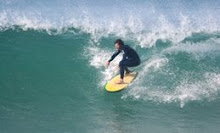
Duke Kahanamoku surfing in Long Beach before the breakwater was installed.

Friday, June 19, 2009

New York Surfers Defy Surfer Stereotype


Photo from: Tyler Hicks/The New York Times

A recent article from the NY Times about surfer's objections of an offshore LNG facility in New York had this quote:

“Our community is both much bigger and far more diverse than people give it credit for,’’ said Chris Wade, the chairman of the Surfrider Foundation’s New York City chapter and one of the organizers of Saturday’s protest. “The average outsider who doesn’t surf has stereotypical ideas of who a surfer is and where they live and we defy those stereotypes here in New York.”

Chris is right and he's also a classic example of someone who defies the surfer stereotype - he was an infantry officer in the Marines, he has an Ivy League education, he has a Masters in History from Duke University, he's a teacher and a very active volunteer for the Surfrider Foundation.

He's also not alone and its also not only a phenomenon in New York.

A paper I wrote on the socioeconomics of surfers Trestles in Southern California had similar findings - surfers tend to be fully employed, well educated and earn high incomes. They essential reflect the communities they come from - that probably shouldn't be a surprise.

To help better understand who surfer's are, Surf First has launched a national survey of surfers to better understand their demographics, surfing habitats and economic impacts to coastal communities. You can check out the survey here.

Tuesday, May 19, 2009

Impacts of Coastal Development on Surfing


Nicolas Corne recently published an interesting paper entitled, "The Implications of Coastal Protection and Development on Surfing" in the Journal of Coastal Research (reference and link below).

The paper is noteworthy because it is one of the only attempts to quantify if coastal structures (groins, jetties, seawalls, breakwaters) are good or bad for surfing. This is common topic of debate within the Surfrider Foundation because we typically fight against coastal structures because they tend to alter coastal process, harm beaches and can destroy surf spots. On the other hand we are aware that many surfing areas are the result of shoreline structures (many of which have still have other negative consequences). This is especially true on the East Coast of the US where there are few natural reefs to make surf spots.

Not too surprisingly this paper finds that coastal protection structures do both, but with the bad out weighing the good for the projects analyzed. Here are some of the other notable elements of the paper.


  • It was found that crowds decreased when wave quality decreased as expected, but surprisingly there were no cases were it was reported that the crowd increased when the surf improved. As suggested this has a lot to do with the proximity of substitute sites.

  • The results show that seawalls, emergent break waters and beach fill tend to reduce wave quality, where as jetties tended to improve wave quality. The "other categorey and "combo" projects showed mixed results.

This paper had a number of short comings that challenge its validity that put it at risk of being a formalization of surfing anecdotes.

  • The survey frame is largely Surfrider Foundation members who may have a bias against shoreline structures that is reflective of the organization's beach preservation policy.

  • The paper doesn't say how many people were surveyed so its impossible to know if the responses are based on one persons opinion or if the results had a wide variation in responses (error bars)

  • The survey asks questions about some places that were altered 10 to 15 years ago (e.g the Wedge in Newport Beach) and it begs the question whether survey respondents are able to truly recall changes in surf quality or if crowds have changed for reasons other than wave quality (the author does acknowledge this shortcoming).
This paper represents a first attempt to quantify the impacts of coastal protection on surfing, which is an admirable research topic. I believe using crowds as a proxy for surf quality is a sound means of estimating changes over time and is something that warrants further research.

Attendance data at surf spots is essential information to better understand the economics, protection and management of surfing areas but has proven difficult to find.

Reference:

CORNE, N.P., 2009. The implications of coastal protection and development on surfing. Journal of Coastal Research, 25(2), 427–434. West Palm Beach (Florida), ISSN 0749-0208.

Download it here.


Thanks to Linwood Pendleton from the Coastal Ocean Values Center for his comments on this post.

Sunday, May 17, 2009

Monster Wave in Super Slo-Mo


High-definition cameras shooting 600 frames reveal the inner dynamics of Monster Waves in the new BBC series South Pacific: Oceans of Islands premiered May 10 on BBC Two. The trailer above shows the first images of underwater spiralling vortices created by the wave’s action, off the coast of Pohnpei in the Caroline Islands, part of the Federated State of Micronesia. Read more about monster waves and super slo-motion techniques here at BBC Earth News.

Thursday, May 7, 2009

Who's Surfing Lowers?

Surfline just posted a little photo expose on "Who's Surfing Lowers". I mapped where they came from here:


View Who's Surfing Lowers in a larger map

Although far from a random sample, I thought it was interesting that it looks somewhat familar to this map that is the result of about 1000 responses to an Internet-based survey:


Surfers are clearly willing to "go the extra mile" to surf Trestles.

Sunday, May 3, 2009

Total Economic Value


Economists often try to measure the value of things. In my case I am interested in using economics to help understand the value of surfing. A common criticism of this approach, beyond the philosophical question about the need to use money to value everything, is that the value of surfing for a day doesn't really capture the entire value of the experience. That is true.

The common techniques used to capture the non-market value of surfing (or other activities) capture a lower bound. The techniques attempt to measure the value of the direct use of the resource.

To try and put that value in context the Total Economic Value framework was established. The other components require non-market valuation techniques.

The illustration above shows the Total Economic Value framework, with examples for surfing.

Read more here and here.

Wednesday, March 18, 2009

Nias: The Golden Pig


The Golden Pig

Documentary about the island of Nias. Provided to us by Australian film director Joel Peterson. The film showcases the dangers of modern surf colonialism, focusing on the impacts it can have on native populations.

The waves at Lagundri Bay on the Indonesian island of Nias are what dreams are made of. The Golden Pig highlights incredible early footage from surf explorer Kevin Peterson along with "first contact" interviews with locals of Nias.

The current state of Nias, surfer paradise or culture destroyed by surfing, remains debated. There is no question that surfing had a profound influence on this community.